
Resolve AI
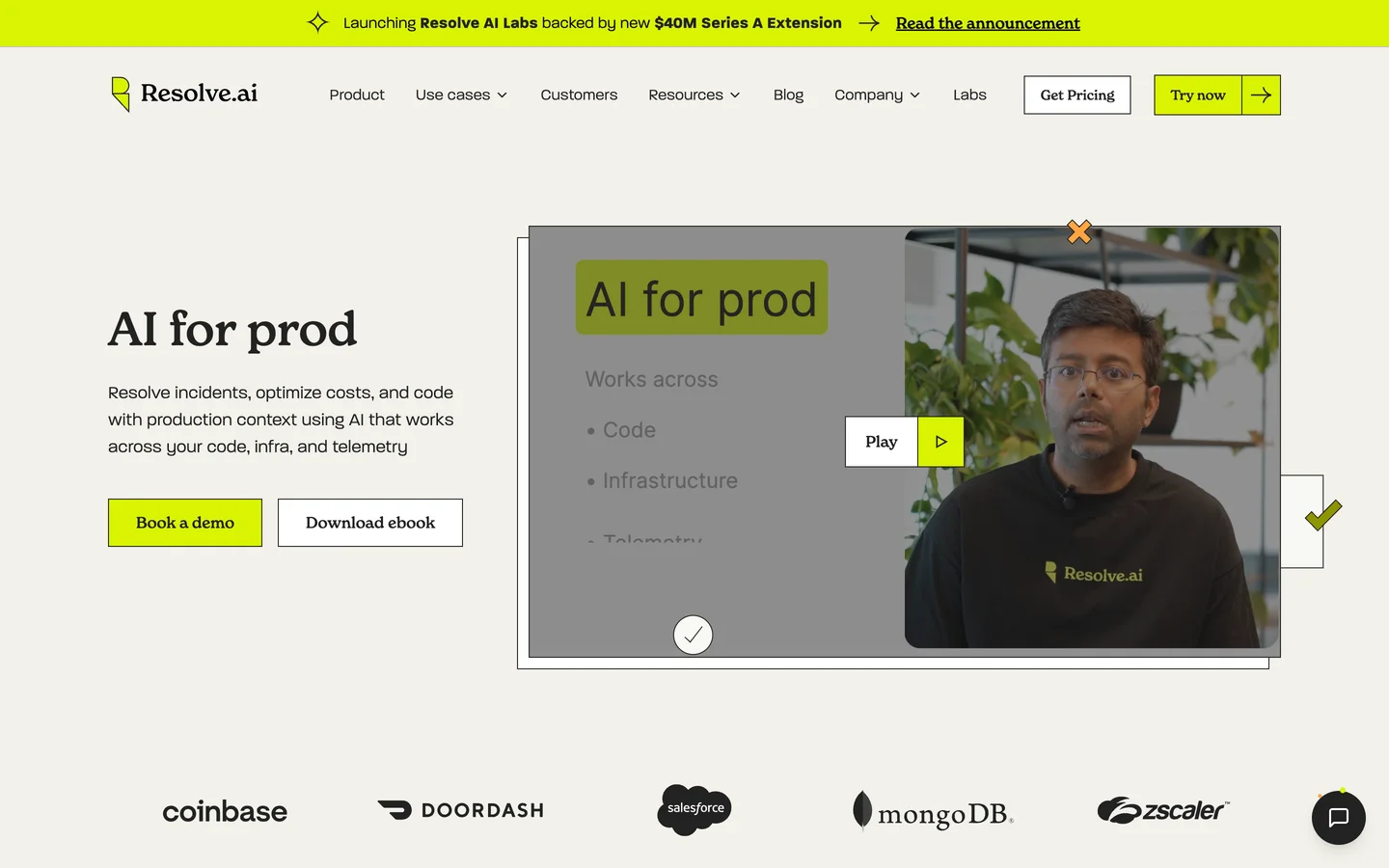
Resolve AI is an enterprise platform of always-on AI agents that act as a first responder for production incidents, taking on-call alerts, running root-cause investigations, and automating routine operational tasks for SRE and platform teams. It connects to existing observability, alerting, and infrastructure tools through APIs, MCP, and webhooks, and is deployed at companies like DoorDash, Coinbase, Snowflake, and Zscaler.
Use Cases
Auto-triage every PagerDuty or Opsgenie alert and hand the on-call engineer a pre-built investigation summary
Run root-cause analysis across logs, metrics, traces, and deploys during a live incident war room
Automate recurring operational tasks like cluster health checks, certificate rotations, and capacity reviews on a schedule
Identify cost-optimization opportunities in cloud infrastructure by spotting oversized workloads
Build custom agents that encode tribal knowledge and runbooks from senior SREs, then expose them to the rest of the team
Embed Resolve AI inside broader agentic workflows by calling it through its MCP server or REST API
Pros
Agents triage every page and start an investigation before a human is in the room, which is the part of on-call that burns engineers out
Investigation Workbench gives engineers and agents a shared surface with inspectable evidence, pullable source queries, and remediation triggered in place
Plugs into existing stacks through MCP server, REST API, webhooks, and a long list of observability and alerting integrations rather than asking teams to rip and replace
Background agents run scheduled or triggered operational work, so the platform covers proactive ops, not just reactive firefighting
Production-grade footprint with named customers like DoorDash, Coinbase, Snowflake, MSCI, and Zscaler, plus a satellite gateway for keeping raw data inside the customer environment
Cons
No public pricing, no self-serve trial, every evaluation runs through a demo and sales cycle
Aimed squarely at mid-to-large engineering orgs with mature observability stacks, small teams without PagerDuty, Datadog, or similar will not see the value
Read-only access by design means agents investigate and recommend but do not push fixes, humans still own remediation
Value scales with how well-instrumented your production environment already is, thin telemetry means thin investigations
Compliance coverage is limited to SOC 2 Type II, GDPR, and HIPAA, regulated buyers needing ISO 27001 or FedRAMP will have to wait
Platforms
Web
API
MCP
Compliance & Certifications
SOC 2
AICPA
GDPR
European Union
HIPAA
U.S. HHS
Resolve AI does the unglamorous middle of an incident, the part where someone has to pull logs, correlate dashboards, and write up what changed before a human can fix it. Its agents sit as a first responder on the on-call rotation and hand engineers a populated investigation by the time they join the call. Sold to platform teams at companies like DoorDash and Coinbase, so pricing is a sales conversation, not a signup.
Solid Choice